How to move a 85 pound telescope without ruining your back
 A major challenge when you own a big 10 inch reflector like the Meade LX200 is moving it. At 85 pounds you can't lift the thing, without major risk of back injury. I've spent a lot of time trying to come up with a better way of moving my telescope.
The first thing I used was the metal tripod roller "Wheeley Bars" the dealer sold me. The problem with that is it raises the center of gravity, together with small, hard 2 1/2" plastic wheels makes it impossible to move over anything other than perfect flat and smooth surfaces, and makes it very easy to tip. The little wheels bind up easily and rattle the scope substantially even moving across smooth concrete. These "Wheeley Bars" are totally useless and dangerous to use, and they cost over $100.
 |
| Wheeley Bar on left, my wooden improvement on right |
So, I improved on that design by building a T shaped tripod roller out of wood with larger 4" wheels. This worked, I could roll the scope fairly easily on concrete, and the bigger wheels turned easily.
All it took to build something better was a couple of 2x4's connected with 2 lag bolts and 3 wheels. Cost to build it about $25. However, with this design, the center of gravity is still high and the scope could tip over if a wheel got stuck, and I don't have smooth concrete on my back patio - I have cobble stones.
In between, I tried taking the scope off the tripod. No good. First, you still have a 50 pound dead weight to carry and second, getting it lined up again on the tripod, even with a mounting guide I bought is hard work. You never want to be hovering around trying to line up this 50 pound scope over the center pin of the tripod, it's actually worst on your back than just picking up the whole scope and tripod in one move. Also I read (I guess a lot of people are doing just this) the number one cause of damage to these types of scopes is cracking the circuit board which is on the underside of the scope, right where the the tripod screw is.
Therefore, I had to attack the problem from another angle, by changing the surface I need to roll over. I did that by getting 4x4 particle boards and laying out a track, complete with a ramp for the one step I needed to go down. This did the trick - with my home made T-bar and track I was able to get the scope safely into position.
However, it was still risky, with the scope riding high and weighing 85 pounds, navigating down even a small ramp was a dangerous maneuver. Also, even with the wheels locked, it was susceptible to more vibration than I liked, sometimes being way off in tracking, and it was a bear to get on and off the T-Bar. And slow. Setting out the track and slowly moving the scope meant much longer setup and take down times.
 |
| The "railroad" 4x4 boards and the 3 wheel casters. Dew caused to edges to warp up. |

While at a local DIY shop I came across 3 wheel casters, for moving furniture. I figured this would be a step backward, as they had 1" wheels, but they were cheap, so I got 3. Much to my surprise, these worked great! I put 1 under each leg of the tripod and since there was a dip in the middle of the casters, the scope was now riding only half an inch off the deck, with three small wheels on each leg, I could easily maneuver it in any direction with one hand. The lower center of gravity makes a huge difference. It was also easy to lift each leg and pop off each caster and have the tripod then directly on the ground. I attached them by making a "grip" out of angel brackets the foot of the tripod leg could sit in.
 If I had a flat surface, this would have been a perfect solution. but I was getting tired of having to "build the railroad" by transporting 8 4x4 particle boards from the shed and lining them up each time I wanted to use the scope. I didn't use the scope as often as I would have liked because of the effort it took to get it outside. The boards wear out within a year and warp, mainly due to moisture (from dew), adding some primer and paint helps, but there's more time and money spent.
It was clear the basic design of wheels under the tripod was at fault, and improving the wheels wasn't a real fix.
I experimented a bit with a hand truck under the tripod, just enough to figure out that tipping the scope on the hand truck and walking backwards was hard on the back and also risky way to move it too.
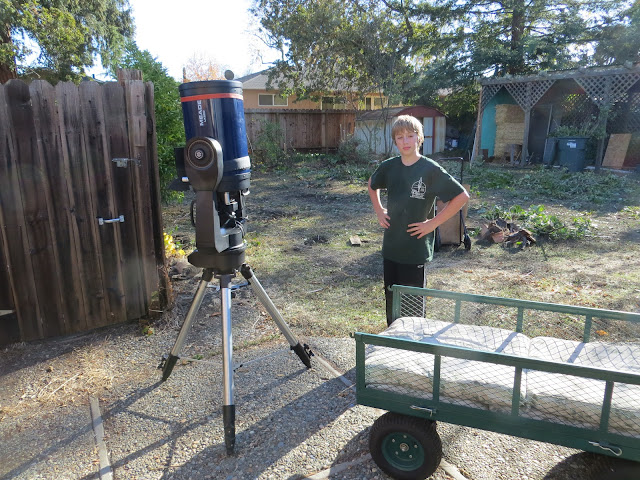
 Now I found a solution that works great! I got a lawn cart, with big, 12" inflatable rubber wheels and a 24" x 48" bed. I took a couple of long cushions from the lawn chairs and lined the bed. I back it up to the scope and carefully tip the scope back onto the cart, this can be done fairly easily, though it is the hardest part. I wheel the cart over the step and across the cobblestones, there's no sharp vibration at all. I tip the scope back up on the tripod legs. Done. I'm out of the house and in position in under 10 minutes.
 Compared to wheels under the tripod, moving via cart is breeze, once it's on the cart you're moving quickly and safely with no risk of damage, as opposed to the tripod mover where you have to inch along and if one wheel get stuck, over the scope goes.
 I also love the fact that with the cart I can go anywhere! Across the grass, into my front yard, even down to the park, no problem. And time - with the tripod movers it took me almost an hour to get the boards out of the shed, lined up, ramp in place, slowly roll the scope along and then carefully lift it off the rollers. Then 2 trips back into the house to haul out the rest of the gear. With the cart, just back it up, lay the scope on it, load on the rest of the gear (cables, eyepieces, battery pack and take off as fast as you care to, tip the scope back up and I'm setup in less than 10 minutes.


The only downside is the tipping onto the cart bit, that takes effort, however so did laying out 8 4x4 boards and picking them up each time. I'm very happy now to have an "all terrain" scope mover, and I can even take this out in the field, over any surface for even a considerable distance. Once you're up from the cart, you're on the deck - no vibration consideration!

 |
| Can run off either house power or a 12v "jump start" battery pack |
Comments
Post a Comment